Was it successful? Why/why not? Yea we won the tallest one but we lost the most earthquake-proof because MR broke our cork so we lost
What do architects do to make super tall building safe?
They plan a strong foundation
Showing posts with label Science. Show all posts
Tuesday, 30 October 2018
Friday, 26 October 2018
Earthquake proof house
Earthquake-resistant structures are structures designed to protect buildings from earthquakes. While no structure can be entirely immune to damage from earthquakes, the goal of earthquake-resistant construction is to erect structures that fare better during seismic activity than their conventional counterparts.
Tuesday, 23 October 2018
Wednesday, 30 May 2018
Testing for carbon dioxide gas and lime water
Testing for carbon dioxide gas
Experiment 1Aim: To show that carbon dioxide gas produced when a metal carbonate reacts with acid.
Method:
- Light your bunsen burner.
- Add a 'Pea-sized' amount of the metal carbonate into one of the boilings tubes.
- Place this boiling tube into a test tube rack. Ensure you have the bung and delivery tube ready.
- Add 5mL of acid to the boiling tube and quickly inserts the bung and delivery tube into the mouth of the boiling tube.
- Holding the other boiling tube with your tongs, capture the gas produced as shown in the diagram.
- When you think the tube is full, your lab partner should light a wooden splint.
- Carefully remove the boiling tube from under the delivery tube, taking care to keep in facing upright.
- Insert the burning splint into the mouth of the test tube.
Observation: It took out the flame
Experiment 2
Method:
- Light your bunsen burner
- Add a 'Pea-sized' amount of the metal carbonate into one of the boilings tubes.
- Place this boiling tube into a test tube rack. Ensure you have the bung and delivery tube ready.
- Buuble gas into limewater
Observation: It becomes cloudy
Thursday, 24 May 2018
Metals and Acids
Metals for Hydrogen Gas
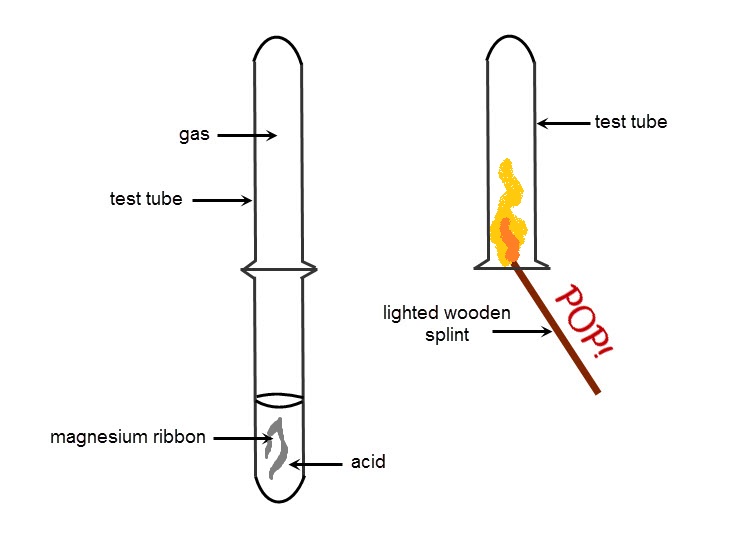
Aim: To show that hydrogen gas is produced when a metal reacts with acid.
Method:
- Light your bunsen burner.
- Add your sample of metal to your test tube. Add 2 mL of acid.
- Carefully invert the boiling tube above the test tube containing the metal and acid (as shown in the diagram below).
- Hold the test tubes together for a few minutes, allowing time for the inverted boiling tube to fill with gas.
- When you think the tube is full, Your lab partner should light a wooden splint.
- Carefully, but quickly, tilt the boiling tube full of gas upwards and insert the burning splint into the mouth of the test tube.

Observation: It will make a loud popping sound.
Thursday, 10 May 2018
Making salts
Making salts
Aim: To produce sodium chloride salt by carrying out a neutralisation reacting.
Method:
- Using the measuring cylinder measure 10 mL of HCl and pour it into your 50mL beaker. Add dilute NaOH a few drops at a time while stirring with the glass rod.
- Every 10-15 drops stop adding the NaOH and use the glass stirring rod to transfer a drop of the solution to a spotting tile. Test its pH using Universal indicator.
- Keep adding NaOH and testing the solution by repeating step 2. As you get closer to neutral you may need to test the solution after every drop.
- Pour the neutral into an evaporating basin and evaporate the water out of the solution using the equipment set up shown above.
Subscribe to:
Posts (Atom)